After a seeminly long absence from the gym, I finally went back to the gym for a short swim. Break time is over, I can't use finishing an Ironman as an excuse anymore. That being said, there are still some exercises I cannot do, due to the bicep tendon tear (resulting in some shoulder pain) and the IT band irritation. But I got back in the pool for a short, easy swim - to ease back into a work-out routine.
Just 1000 meters, which at one point sounded like a long swim. Now, having done training sessions of over 2 miles in open water and many sessions of over 3000 meters in a lap pool, 1000 meters did not sound difficult. However, getting into the water for the first time in weeks felt foreign. The natural grab and pull of the water felt a bit different. I didn't feel as smooth and I felt like my technique has gone to crap. Did two hundred meters' worth of drills, but I think I'll be doing more drills soon.
If that wasn't enough of a sign that I need to get back into the gym, another sure sign that it has been far too long is the fact that I nearly forgot the combination to my lock. After standing in front of my locker trying different combinations of the three numbers I thought was the correct numbers, I finally got lucky - only after realizing that the three numbers I originally believed to be the combination weren't correct!
Yes, it's time to get back into the routine.
Falling Apart: The Knee
Knee pains have bothered me since the beginning of training and right through Ironman Arizona. Usually appearing only during long training runs, the pain is pretty sharp, on the outside bone of the knee. Yes, I'm lacking any actual medical terminology, but then again, I'm not a scientist.
Unfortunately, even after complete rest for nearly two weeks, the pain still comes back during training runs. Yesterday, an attempt at an easy few miles was cut short when the pain hit just past mile 2, and forced me to stop when the pain continued to get worse at mile 3. This is not a good sign, as the pain usually does not occur so early.
It's time to start doing IT band stretches and being more careful with it. Even though Ironman Arizona is behind me now, Iron Sherpa is still sherpaing. She already bought me an IT band/knee brace which has garnered multiple positive reviews for being helpful. I'll have to try it soon.
![]() |
| That's not my butt |
A visit to the physical therapist, who advised me that the knee pain is actually due to my Iliotibial band (IT band). Anti-inflammatory medicine should help - which is great since I already have a stash of 800mg ibuprofens.
It's time to start doing IT band stretches and being more careful with it. Even though Ironman Arizona is behind me now, Iron Sherpa is still sherpaing. She already bought me an IT band/knee brace which has garnered multiple positive reviews for being helpful. I'll have to try it soon.
Post-Race Time; Post Traumatic Stress Disorder
One of my friends competed in Ironman way back in 1982 - well before the Ironman series became such a large commercial success, and raced with the Ironman legends (Dave Scott and others). He warned me of Post Traumatic Stress Disorder (in a lighthearted way, not to make light of the real Post Traumatic Stress Disorder affecting many of our nation's soldiers). He jokingly tells me about dreams/'nightmares' he gets about the Ironman still.But other than one dream, post-Ironman Arizona has been relatively stress-free. Finally went to see a physical therapist for injuries sustained during an October bike spill while training.
Not only has my schedule been stress-free, but it's also been mostly exercise-free. Other than a 9 minute high-intensity stair climb (up 50 flights of stairs) as a part of a benefit for the Cystic Fibrosis Foundation, I've done very little. The itch is back to start swimming, riding and running again. Weather has not been cooperating but that's a weak excuse. It's time to get back on the horse again.
Ironman Arizona: The Best Part [Part 2]
Pre-race Sherpa facebook posts are here. And now we continue with her posts during the race!
What a day. As much as I accomplished that day, Sherpa was obviously one busy girl all day too!
Many thanks to Sherpa for all of her support, time, effort and sacrifices. Many thanks to all of my (and her) friends who commented and liked the posts and otherwise showed endless support on our successful Ironman endeavor!
| Beginning of the swim. At this point, I've been in the water for 15 minutes already, waiting for the cannon to signal the start of Ironman Arizona. She's posted up by the swim finish, camera in hand and ready to cheer me on. And yes, I agree. She's the best Sherpa ever. |
| My first Sherpa sighting! |
| As I get through transition and on the bike, she knows she's got a bit of downtime while I go about making my first loop on the bike course. She later tells me she noticed my first bike split was rather slow and was a bit worried. What she didn't know at the time was my fight with the street sign and my flat, both of which are reflected in my slow first bike split. |
| She's got her timing down, estimating when I would pass through our pre-arranged cheering spot. |
| Off to the run! Two thumbs up on the outside, but my knee was already hurting by this point. Didn't want to show the pain though. Guess I covered it up pretty well. |
| Always thinking ahead! What would I do without her? |
| Even I thought the kiss was salty. :p |
Many thanks to Sherpa for all of her support, time, effort and sacrifices. Many thanks to all of my (and her) friends who commented and liked the posts and otherwise showed endless support on our successful Ironman endeavor!
Ironman Arizona: The Best Part [Part 1]
It's been just over two weeks since I finished Ironman Arizona. I've had a chance to blog about the experience a bit, talk with a number of people, both who have done Ironman event in the past and family and friends who wanted to know more about my experience. I also had some time to reflect on the experience - and it was definitely a good experience.
Among the most frequently asked question is "What was the best part?"
Many times the question is asked with the qualifier, "not counting the finish..." But I don't even think the finish was the best part. Maybe second best. Crossing the finish line, rather than a sense of accomplishing a once-in-a-lifetime achievement and feeling on top of the world, I felt more relief. Relief the race was over, that I did (and can tell people that I did) what I had set out to do. It was relief that the time, energy, effort, money, and sacrifices was for something.
But the best part? The best part was walking back to the hotel room after everything was done and having Iron Sherpa tell me about her day. Running around like a maniac (my words, not hers) to make sure she saw me as often as possible and live facebook-blogging my entire race. Then getting to the hotel room and her telling me to get on the computer and take a look at all the facebook activity that occurred through the day.
That was the best part of the day. Take a look. Below each of Iron Sherpa's facebook post includes a link to my corresponding blog post. Kinda neat to get insider her head too.
Next up... Iron Sherpa's facebook posts during the actual race.
Among the most frequently asked question is "What was the best part?"
Many times the question is asked with the qualifier, "not counting the finish..." But I don't even think the finish was the best part. Maybe second best. Crossing the finish line, rather than a sense of accomplishing a once-in-a-lifetime achievement and feeling on top of the world, I felt more relief. Relief the race was over, that I did (and can tell people that I did) what I had set out to do. It was relief that the time, energy, effort, money, and sacrifices was for something.
But the best part? The best part was walking back to the hotel room after everything was done and having Iron Sherpa tell me about her day. Running around like a maniac (my words, not hers) to make sure she saw me as often as possible and live facebook-blogging my entire race. Then getting to the hotel room and her telling me to get on the computer and take a look at all the facebook activity that occurred through the day.
That was the best part of the day. Take a look. Below each of Iron Sherpa's facebook post includes a link to my corresponding blog post. Kinda neat to get insider her head too.
| Arrival in Tempe. So many friends cheering me on from afar! |
| Thursday before IMAZ. Biggest decision of the weekend... strip club or zoo? |
| Friday night before IMAZ, the energy and electricity of Ironman is enveloping us. |
| Ironman's Eve. Is she just too cute or what?! And it's true, I really did/do appreciate hearing from and seeing posts from so many friends. |
| Still Ironman's Eve. This is the post that was visible to me. Sneaky girl, that one! |
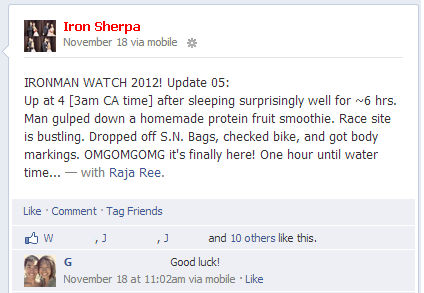
| Our super-early morning, day of Ironman Arizona. I think she posted this up when I went off to get body markings. Not sure which one of the two of us was more nervous about the race... |
Ironman Arizona: T2 and the Run
I will be posting a mini-series of posts to describe the day of Ironman Arizona. This is the fifth installment of this series.
Getting into T2, I knew there was a problem. Though I pushed it a little harder for the third loop of the bike, I felt fine overall... except for my left knee.
The Run.
Target Time: 4:00 to 4:30
X-Factor: Knee pain; running a marathon after the bike ride.
Strategy: Start with ten minute miles. Walk through each aid station and get hydration and nutrition.
Result: 5:34
Right off the bat, I knew a ten minute mile would be impossible. Other than my knee, physically I felt fine. Mentally, I knew I was almost home and all I had to do at this point was keep moving forward. The aid stations were spaced more or less a mile apart from each other. This helped me break the run into small, doable segments. At each aid station, I would, at a minimum, take a small cup of Perform energy drink, a water and a piece of banana. Every few miles, I also took in a mini nutrition bar they offered. As the sun set, the aid stations also offered chicken broth, which is rich in sodium - I started taking the broth instead of the energy drink. Since not all aid stations had the same food (some also had pretzels, chips, or coke, while some didn't have broth), I always took whatever they offered towards the beginning of the station just in case. That way, at least I'd have something to drink or eat.
Unfortunately, the knee pain never went away. I had to grit my teeth and just deal with it for the entire 26.2 miles. At times, the pain felt a bit lighter and I'd try to pick up the pace. Mostly though, I dealt with the pain by trying to not bend the knee while doing a light jog. My legs certainly became sore and stiff during the run, but since I was keeping it pretty easy, I still felt I could have pushed much harder, if not for the knee.
With a finishing time of just under fourteen hours, I can't say I'm unhappy with the result. I finished; I'm an Ironman. But with a healthy knee, I'm sure I could have done much faster... perhaps next time?
Quick Facts:
Nutrition: At each aid station, take in a minimum of a piece of banana, energy drink and water. Towards the end, substitute broth for energy drink, also take in mini nutrition bars on occasion.
Ironman Arizona Series:
Result
A Really Really Early Morning
The Swim
T1 and the Bike
Getting into T2, I knew there was a problem. Though I pushed it a little harder for the third loop of the bike, I felt fine overall... except for my left knee.
The Run.
Target Time: 4:00 to 4:30
X-Factor: Knee pain; running a marathon after the bike ride.
Strategy: Start with ten minute miles. Walk through each aid station and get hydration and nutrition.
Result: 5:34
Right off the bat, I knew a ten minute mile would be impossible. Other than my knee, physically I felt fine. Mentally, I knew I was almost home and all I had to do at this point was keep moving forward. The aid stations were spaced more or less a mile apart from each other. This helped me break the run into small, doable segments. At each aid station, I would, at a minimum, take a small cup of Perform energy drink, a water and a piece of banana. Every few miles, I also took in a mini nutrition bar they offered. As the sun set, the aid stations also offered chicken broth, which is rich in sodium - I started taking the broth instead of the energy drink. Since not all aid stations had the same food (some also had pretzels, chips, or coke, while some didn't have broth), I always took whatever they offered towards the beginning of the station just in case. That way, at least I'd have something to drink or eat.
Unfortunately, the knee pain never went away. I had to grit my teeth and just deal with it for the entire 26.2 miles. At times, the pain felt a bit lighter and I'd try to pick up the pace. Mostly though, I dealt with the pain by trying to not bend the knee while doing a light jog. My legs certainly became sore and stiff during the run, but since I was keeping it pretty easy, I still felt I could have pushed much harder, if not for the knee.
![]() |
| Sunset during IMAZ |
Quick Facts:
Nutrition: At each aid station, take in a minimum of a piece of banana, energy drink and water. Towards the end, substitute broth for energy drink, also take in mini nutrition bars on occasion.
Ironman Arizona Series:
Result
A Really Really Early Morning
The Swim
T1 and the Bike
Ironman Arizona: T1 and the Bike
I will be posting a mini-series of posts to describe the day of Ironman Arizona. This is the fourth installment of this series.
Coming out of the swim, I felt pretty fresh. Upon coming out of the water, a wetsuit stripper had me sit on the ground and he pulled the suit right off of me. I don't think I've ever gotten out of a wetsuit so quickly or with so little effort (on my part, anyway). Then it was a light jog to grab my T1 bag, which included all my my bike gear. All of my swim gear would then be placed in the T1 bag and given to the volunteers (and then to be picked up after the race). Into the changing tent, where I took my time getting into the bike gear, hydrating and eating a bit before setting out. Volunteers just outside the changing tent slathered me up with sunblock and then it was off to find my bike!
Once again, helpful volunteers were all over the place to help athletes to their bikes. Upon seeing me coming into transition, the volunteers yelled ahead to other volunteers to grab my bike (#341).
My T1 time was 13 minutes so I clearly took my time - all a part of the strategy.
Then, it was onto the bike course.
Target Time: 6:00 - 6:30
X-Factor: Cross-winds; carbon/disc wheels
Strategy: Keep the ego in check. Coach told me to keep my heart rate below 130 bpm. This means a lot of people would b passing me early on the course. The plan was to conserve energy since it is a long course, and there is still a marathon to run. With three loops of the bike course, I would be able to evaluate how I felt after each loop and then decide whether or not to step up the heart rate.
Result: 6:32
Coming out of transition, I felt good. The bike portion is my favorite part, and I knew that keeping it at 130 bpm meant taking my time and enjoying myself. However, even after 13 minutes spent in transition, my heart rate walking out of the changing tent was already 145 bpm. It seemed that a low heart rate would be virtually impossible. If I couldn't get my heart rate that low while walking, how would I be able to lower my heart rate on the bike?
After settling in on the bike, I tried to regulate my breathing in an attempt to lower my heart rate. With my Garmin attached to my handle bars, I regularly checked and re-checked my heart rate - but it jumped up and all over the place (at times peaking over 200 bpm, which made me think it was reading more than just my heart rate monitor, since I was taking it pretty easy at that point). No matter what I did, I couldn't settle my heart down.
Just one mile in (of 112 miles), I was looking down at my Garmin and concentrating on my breathing as I look up to see a "KEEP RIGHT" sign a bit too close in front of me. The sign was directed at automotive traffic, so athletes were to stay on the left. For a split second, I probably instinctively tried to go right before realizing I'm supposed to go left. At any rate, I smacked right into the sign, lost the bike and came tumbling down, sliding across the lane.
Luckily, no other athletes were immediately behind me and two course volunteers were nearby to help me up and get my bike. A few scrapes on the knee and back, but otherwise I was okay. The bike gave me a good scare - I thought my day was already over. Luckily, it was just a loose chain, twisted seat post and a bent hood. After man-handling the seat post to straighten it out, I was off again. That whole episode definitely did not help with the heart rate situation, but I was able to quickly put it behind me as I looked forward to a long ride at an easy pace.
The course zig-zags through the city, then onto Beeline Highway and back, for three loops.
Once on Beeline Highway, I thought it would be smooth sailing. The crash was already out of my mind and I was on auto-pilot. Except I was unusually slow. Testing on the disc wheels showed I should be able to maintain at least 17mph even at 130bpm. However, I was doing between 13 and 15 mph instead. I watched as numerous athletes passed me, seemingly easily. I continued to keep the ego in check, remembering that after they are all out of steam, I'd still have plenty of gas to go on. I watched as one particular female athlete in pink and purple, with matching bicycle and sparkling helmet, pass me.
Just past mile 13, I pulled over to give my bike another visual inspection - I began wondering if my brakes might be stuck or if there was some other issue with the bike following the accident. As it turned out, my rear tire was hissing - it was deflating, steadily making me slower. As soon as I pulled over, course marshals in a pickup stopped to help me. With their help changing the rear tube, I was back on the road in five minutes (although it felt like 15 minutes). Now with a fully inflated tube, I was ready to roll.
Although 130 bpm was impossibly low, I was able to maintain a 140 or below bpm for the first loop. Feeling surprisingly fresh, I decided to kick it up a notch for the second loop. At the very beginning of the second loop, I passed the sparkly helmeted pink-and-purple girl and never looked back. This was clear evidence that the race strategy was working. Throughout the second loop, I began regularly passing other athletes; some who I recognized from the first loop, and a great many anonymous other athletes. Still sticking with the plan, I tried to not get above 145 bpm.
On long rides and any endurance event, nutrition is critically important. For Ironman Arizona, I packed 2 powerbars, a Kashi bar, 2 Gu packets and 2 packets of Clif bloks. A special needs bag I accessed during the second half of my second loop included some more nutrition, although I was happy to eat the mini-bars, gels and snacks at the aid stations too. Since there is a run afterward, I was warned to eat solid foods early (as running and the long Ironman day may have adverse effects on my gastrointestinal system) and to maintain a 200-250 calorie per hour intake schedule, which I did fairly easily. One of the benefits of the numerous long rides and runs during training is that I became very in tune with my body, usually able to recognize how much nutrition I will need before I get hungry or tired due to lack of calories. The 200-250 calories per hour decision was made through trial and error testing during training.
Back to the bike. By the third loop, I was feeling really great; the flat and the crash were nothing but a distant memory. I allowed the heart rate to get up to 155 bpm, though I spent most of the last loop in the 140's. At this late point, I was regularly and quickly passing many athletes. I was, however, still being passed by a few triathlon bikes. The strategy worked out perfectly. I felt strong.
The only problem? My left knee started hurting. It was a pain I felt before, mostly from long runs. It was something I hoped would disappear with a bit of ibuprofen, and something I feared would ruin my run. But we'l save that for next time.
Although I was just shy of my target, I think without the early issues, I would have easily came in within the target times. But that's all a part of racing!
Quick Facts:
Strategy: The tortoise wins the race.
Nutrition: More solid foods early on. Intake of 200-250 calories per hour.
Ironman Arizona Series
Results
A Really Really Early Morning
The Swim
Coming out of the swim, I felt pretty fresh. Upon coming out of the water, a wetsuit stripper had me sit on the ground and he pulled the suit right off of me. I don't think I've ever gotten out of a wetsuit so quickly or with so little effort (on my part, anyway). Then it was a light jog to grab my T1 bag, which included all my my bike gear. All of my swim gear would then be placed in the T1 bag and given to the volunteers (and then to be picked up after the race). Into the changing tent, where I took my time getting into the bike gear, hydrating and eating a bit before setting out. Volunteers just outside the changing tent slathered me up with sunblock and then it was off to find my bike!
![]() |
| Lonely bike in transition |
![]() |
| What transition actually looks like, with volunteers helping me to my bike. |
My T1 time was 13 minutes so I clearly took my time - all a part of the strategy.
Then, it was onto the bike course.
Target Time: 6:00 - 6:30
X-Factor: Cross-winds; carbon/disc wheels
Strategy: Keep the ego in check. Coach told me to keep my heart rate below 130 bpm. This means a lot of people would b passing me early on the course. The plan was to conserve energy since it is a long course, and there is still a marathon to run. With three loops of the bike course, I would be able to evaluate how I felt after each loop and then decide whether or not to step up the heart rate.
Result: 6:32
![]() |
| The meeting of the signs as they make their dastardly plans |
After settling in on the bike, I tried to regulate my breathing in an attempt to lower my heart rate. With my Garmin attached to my handle bars, I regularly checked and re-checked my heart rate - but it jumped up and all over the place (at times peaking over 200 bpm, which made me think it was reading more than just my heart rate monitor, since I was taking it pretty easy at that point). No matter what I did, I couldn't settle my heart down.
Just one mile in (of 112 miles), I was looking down at my Garmin and concentrating on my breathing as I look up to see a "KEEP RIGHT" sign a bit too close in front of me. The sign was directed at automotive traffic, so athletes were to stay on the left. For a split second, I probably instinctively tried to go right before realizing I'm supposed to go left. At any rate, I smacked right into the sign, lost the bike and came tumbling down, sliding across the lane.
Luckily, no other athletes were immediately behind me and two course volunteers were nearby to help me up and get my bike. A few scrapes on the knee and back, but otherwise I was okay. The bike gave me a good scare - I thought my day was already over. Luckily, it was just a loose chain, twisted seat post and a bent hood. After man-handling the seat post to straighten it out, I was off again. That whole episode definitely did not help with the heart rate situation, but I was able to quickly put it behind me as I looked forward to a long ride at an easy pace.
The course zig-zags through the city, then onto Beeline Highway and back, for three loops.
Once on Beeline Highway, I thought it would be smooth sailing. The crash was already out of my mind and I was on auto-pilot. Except I was unusually slow. Testing on the disc wheels showed I should be able to maintain at least 17mph even at 130bpm. However, I was doing between 13 and 15 mph instead. I watched as numerous athletes passed me, seemingly easily. I continued to keep the ego in check, remembering that after they are all out of steam, I'd still have plenty of gas to go on. I watched as one particular female athlete in pink and purple, with matching bicycle and sparkling helmet, pass me.
![]() |
| Iron Sherpa posted up along the route to snap pictures and cheer me on. |
Although 130 bpm was impossibly low, I was able to maintain a 140 or below bpm for the first loop. Feeling surprisingly fresh, I decided to kick it up a notch for the second loop. At the very beginning of the second loop, I passed the sparkly helmeted pink-and-purple girl and never looked back. This was clear evidence that the race strategy was working. Throughout the second loop, I began regularly passing other athletes; some who I recognized from the first loop, and a great many anonymous other athletes. Still sticking with the plan, I tried to not get above 145 bpm.
On long rides and any endurance event, nutrition is critically important. For Ironman Arizona, I packed 2 powerbars, a Kashi bar, 2 Gu packets and 2 packets of Clif bloks. A special needs bag I accessed during the second half of my second loop included some more nutrition, although I was happy to eat the mini-bars, gels and snacks at the aid stations too. Since there is a run afterward, I was warned to eat solid foods early (as running and the long Ironman day may have adverse effects on my gastrointestinal system) and to maintain a 200-250 calorie per hour intake schedule, which I did fairly easily. One of the benefits of the numerous long rides and runs during training is that I became very in tune with my body, usually able to recognize how much nutrition I will need before I get hungry or tired due to lack of calories. The 200-250 calories per hour decision was made through trial and error testing during training.
Back to the bike. By the third loop, I was feeling really great; the flat and the crash were nothing but a distant memory. I allowed the heart rate to get up to 155 bpm, though I spent most of the last loop in the 140's. At this late point, I was regularly and quickly passing many athletes. I was, however, still being passed by a few triathlon bikes. The strategy worked out perfectly. I felt strong.
The only problem? My left knee started hurting. It was a pain I felt before, mostly from long runs. It was something I hoped would disappear with a bit of ibuprofen, and something I feared would ruin my run. But we'l save that for next time.
Although I was just shy of my target, I think without the early issues, I would have easily came in within the target times. But that's all a part of racing!
![]() |
| Pushing onward. Mile 71, passing on the left. |
Strategy: The tortoise wins the race.
Nutrition: More solid foods early on. Intake of 200-250 calories per hour.
Ironman Arizona Series
Results
A Really Really Early Morning
The Swim
Subscribe to:
Posts (Atom)


